Vietnamese
 English
 Korean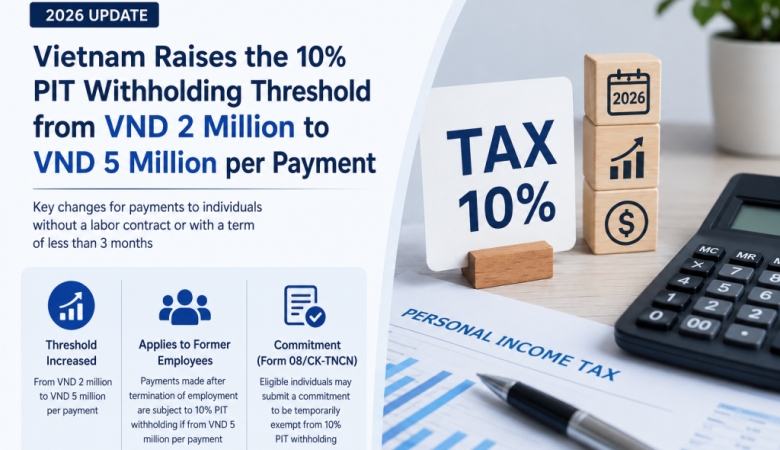
Vietnam Raises the 10% Personal Income Tax (PIT) Withholding Threshold from VND 2 Million to VND 5 Million per Payment Effective 2026
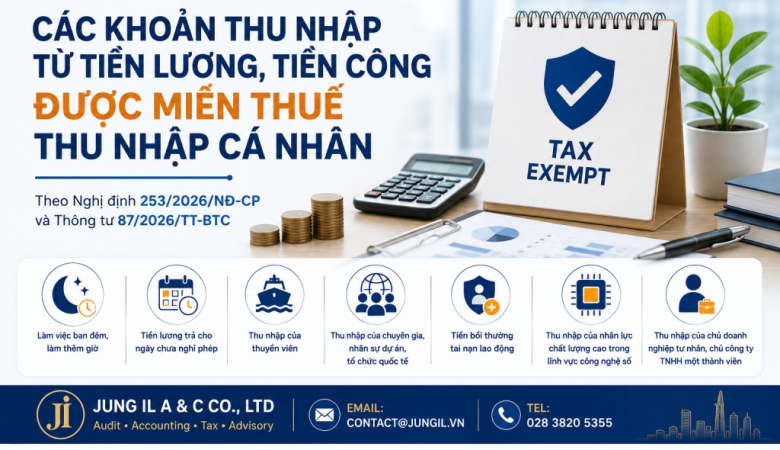
Under Clause 2, Article 50 of Decree No. 253/2026/ND-CP, Vietnam has introduced significant changes to the Personal Income Tax (PIT) withholding rules applicable to resident individuals who do not sign labor contracts or who enter into labor contracts with a term of less than three months. These changes will take effect in 2026 and are important for employers, payroll teams, and HR professionals to understand and implement.
1. PIT Withholding Threshold Increased from VND 2 Million to VND 5 Million per Payment
From 2026, organizations and individuals paying income to resident individuals who do not have a labor contract or have a labor contract with a term of less than three months are required to withhold 10% PIT on the gross payment if the amount paid is VND 5 million or more per payment.
This represents an increase from the previous withholding threshold of VND 2 million per payment, reducing the number of low-value payments subject to mandatory PIT withholding.
For payments of less than VND 5 million per payment, withholding is generally not mandatory. However, if the recipient requests PIT withholding, the payer may still withhold 10% accordingly.
2. Important Change for Payments Made After Employment Termination
One of the most notable changes under the new regulation concerns payments made to former employees after their employment has ended.
If an employer pays salary, bonuses, or other employment-related income after the employee has terminated the labor contract, and the payment is VND 5 million or more per payment, the employer must withhold 10% PIT at the time of payment.
This rule applies even if the income was earned during the employment period and would otherwise have been subject to the progressive PIT rates while the employment relationship was still in effect.
Example
An employee terminates his or her labor contract on 1 July 2026.
On 10 July 2026, the employer pays the employee's June salary amounting to VND 12 million.
Because the payment is made after the employment relationship has ended, and the payment exceeds VND 5 million, the employer must withhold 10% PIT before making the payment, instead of calculating PIT under the progressive tax rate schedule.
Employers should pay particular attention to this new requirement when making salary, bonus, severance, or any outstanding payments to former employees.
3. Cases Where the 10% PIT Withholding May Be Waived
A resident individual may request that the payer temporarily not withhold the 10% PIT by submitting Form No. 08/CK-TNCN, provided that all of the following conditions are satisfied:
- The individual is a resident taxpayer.
- The individual has registered for tax and obtained a Tax Identification Number (TIN) before submitting the commitment.
- The individual has only one source of income that is subject to the 10% withholding rule.
- The individual's estimated annual taxable income, after deducting family circumstance relief and other allowable deductions, does not exceed the taxable threshold.
Where these conditions are met, the income payer may rely on the individual's commitment and temporarily refrain from withholding 10% PIT.
4. What Should Employers Do?
To ensure compliance with the new regulations from 2026, employers are advised to:
- Update payroll procedures to apply the new VND 5 million per payment withholding threshold.
- Review payroll processes for payments made to former employees to ensure the correct PIT withholding method is applied.
- Inform employees about the eligibility requirements for submitting Form No. 08/CK-TNCN, enabling qualified individuals to avoid unnecessary PIT withholding.
Conclusion
The increase in the PIT withholding threshold from VND 2 million to VND 5 million per payment is a welcome change that reduces withholding obligations for lower-value payments. However, employers should also pay close attention to the new rule requiring 10% PIT withholding on payments made to employees after the termination of their labor contracts, as this may significantly affect payroll processing and tax compliance procedures.
By updating internal payroll policies and systems in a timely manner, businesses can minimize tax risks while ensuring full compliance with Vietnam's latest Personal Income Tax regulations.