Vietnamese
 English
 Korean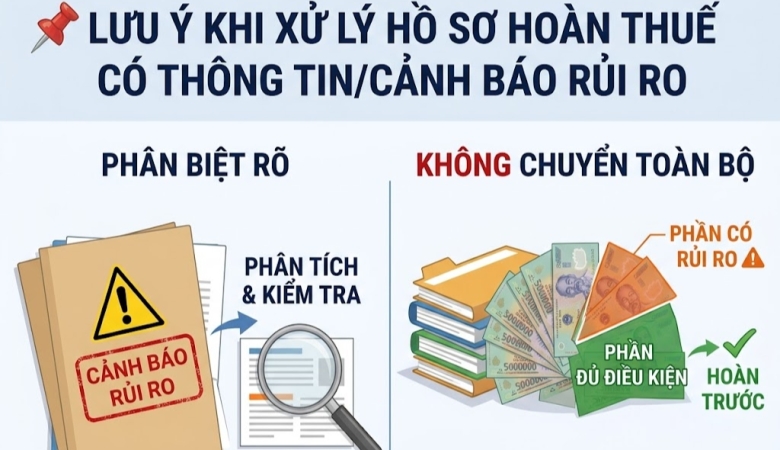
VAT REFUND APPLICATIONS INVOLVING RISK INFORMATION
In accordance with the guidance provided in Official Letter No. 6936/CT-QLTT dated September 18, 2026, issued by the Tax Department.
In the course of processing Value Added Tax (VAT) refund applications, risk information relating to suppliers, invoices, or entities within the supply chain is increasingly used as an important source of data for tax administration and risk management.
However, it is important to clearly distinguish between risk information/warnings and the results of inspection and verification establishing a violation or determining that the taxpayer is not eligible for a VAT refund. The fact that a supplier or an entity within the supply chain is subject to a risk warning does not, in itself, mean that the underlying transaction did not actually occur, that the invoice is unlawful, or that the corresponding input VAT claimed by the taxpayer is automatically ineligible for refund.
The following are key principles for the classification and processing of VAT refund applications involving risk information.
1. Distinguishing Risk Information from a Finding of Violation
In the processing of VAT refund applications, three levels of information should be distinguished:
Risk information and warnings:
Data used for risk assessment, risk classification, and determining the matters that require review and verification.
Classification results on the Tax Administration Information System:
The results identifying whether a VAT refund application, or part of the amount claimed for refund, presents tax administration risks.
Inspection and verification results:
The basis for determining whether the taxpayer satisfies the conditions for a VAT refund, whether the underlying transaction actually occurred, whether the relevant invoice is lawful, and whether any violation has occurred.
Accordingly, a risk warning does not constitute a finding of violation.
Risk information relating to suppliers, invoices, or entities within the supply chain serves only as input data for the tax authority to assess risks and determine the matters requiring inspection and verification.
Only where inspection or verification results, or a conclusion issued by a competent authority, provide sufficient grounds to establish that:
- The invoice is unlawful;
- The transaction did not actually occur;
- The taxpayer does not satisfy the conditions for a VAT refund; or
- The taxpayer has committed a violation,
May the tax authority refuse the refund, recover an amount previously refunded, or take other measures in accordance with applicable regulations.
2. Processing VAT Refund Applications Based on Risk Classification Results
2.1. Applications Eligible for Refund Before Inspection
Where the Tax Administration Information System determines that part of the amount claimed for refund presents tax administration risks, the tax authority shall notify the taxpayer that such amount is subject to pre-refund inspection in accordance with applicable regulations.
The remaining amount shall continue to be processed under the refund-before-inspection procedure and may be refunded once all applicable refund conditions are satisfied.
This means that: Where only part of the amount claimed for refund presents risks, the entire VAT refund application or the entire amount claimed for refund should not automatically be transferred to the pre-refund inspection procedure.
The portion that does not present such risks should continue to be processed in accordance with the applicable refund-before-inspection procedure, unless the entire application falls within a statutory case requiring pre-refund inspection.
2.2. Applications Subject to Pre-Refund Inspection
Under Article 30 of Decree No. 252/2026/ND-CP, certain VAT refund applications are subject to pre-refund inspection, including:
- VAT refund applications submitted by a taxpayer for the first time in respect of each type of VAT refund prescribed under tax regulations.
- VAT refund applications submitted by a taxpayer within two years from the date on which the taxpayer was sanctioned for tax evasion.
- A VAT refund application, or part of the amount claimed for refund, that is determined to present a high level of tax administration risk.
- VAT refund applications submitted by an enterprise or organization in the course of dissolution or bankruptcy.
For applications subject to pre-refund inspection, the tax authority shall conduct the inspection and verification in accordance with applicable regulations and determine, based on the inspection results:
- The amount eligible for VAT refund;
- The amount not eligible for VAT refund; and
- The amount not yet eligible for VAT refund.
In particular, the classification of a portion of the refund amount as high risk should be distinguished from the mere existence of risk information or warnings concerning a supplier or another entity in the supply chain.
3. Risk Information Relating to Suppliers and Entities in the Supply Chain
For risk management based on the amount of VAT refund claimed, the supply chain may generally be understood as follows:
F1: The supplier that directly issues the invoice to the taxpayer claiming the VAT refund;
F2: The entity supplying goods or services to F1;
F3: The entity supplying goods or services to F2;
and other entities at subsequent levels of the supply chain.
Risk information relating to F2, F3 and subsequent levels may be used as input data for the Tax Administration Information System to assess, aggregate and convert the level of risk to F1 in accordance with applicable risk management criteria and methodology.
Important Note
Where F2, F3 or an entity at a subsequent level is subject to a risk warning, such warning should not, by itself, be used as a basis to immediately conclude that the corresponding input VAT claimed by the taxpayer is ineligible for refund.
Similarly, where F1 has not been identified as presenting a risk but F2, F3 or subsequent entities are subject to risk warnings, the tax authority should not, solely on the basis of such information, automatically:
- Transfer the corresponding input VAT amount to the pre-refund inspection procedure;
- Conclude that the transaction did not actually occur;
- Conclude that the invoice is unlawful; or
- Conclude that the taxpayer is not eligible for a VAT refund.
Risk information relating to F2, F3 and subsequent entities should instead be used to assess and convert the relevant risk to F1 and determine the appropriate matters requiring review and verification in accordance with applicable regulations.
Suppliers with Issues Regarding Their Operating Status
Information indicating that a supplier:
- presents invoice-related risks;
- has ceased operations and is undergoing procedures for termination of its tax identification number;
- is not operating at its registered address;
- is undergoing dissolution; or
- has ceased operations;
may be used for tax risk management purposes.
However, such information does not automatically constitute a basis for concluding that the transaction did not actually occur, that the invoice is unlawful, or that the VAT refund application is ineligible.
The tax authority should conduct the necessary review, inspection and verification before reaching a formal conclusion.
4. Key Considerations for Businesses Applying for VAT Refunds
Based on the above principles, businesses applying for VAT refunds should pay particular attention to maintaining complete documentation evidencing the actual occurrence of transactions and the legality of relevant invoices and supporting documents.
Businesses should maintain adequate records, including:
- Economic contracts;
- Purchase orders, quotations and transaction agreements;
- VAT invoices;
- Bank payment documents;
- Goods receipt and goods issue notes;
- Goods delivery and handover records;
- Transportation documents;
- Import/export documentation, where applicable;
- Documents evidencing the origin of goods;
- Acceptance and completion records for services; and
- Other documents supporting the actual occurrence of the transactions.
In particular, for businesses conducting transactions through multiple levels of the supply chain, effective monitoring of supplier information and proper retention of documents evidencing the actual transactions can help businesses respond proactively when the tax authority requests explanations or conducts verification procedures.
5. Key Takeaways for Businesses
The principles governing the processing of VAT refund applications involving risk information can be summarized as follows:
Risk warning ≠ Finding of violation.
Risk at F2/F3 ≠ Automatic determination that the F1 invoice is unlawful.
The supplier's failure to declare or pay VAT ≠ Automatic loss of the purchaser's VAT refund entitlement for refund periods subject to the regulations effective from 1 January 2026.
Risk relating to part of the refund amount ≠ Automatic transfer of the entire refund amount to pre-refund inspection.
The determination of the amount eligible for refund, the amount not eligible for refund, or the amount requiring further inspection and verification should be based on the relevant risk classification results and the results of inspection and verification in accordance with applicable laws and regulations.
At the same time, businesses should proactively establish appropriate controls over invoices, supporting documents and transaction records, particularly for high-value transactions or transactions involving multiple levels of the supply chain.